
Choosing a sofa or repainting a wall is not enough to transform a room. The success of interior decoration relies on a precise set of equipment, from measuring tools to textiles, including lighting. Each element serves a technical function that is often underestimated when starting out.
Air Quality and Labeling: What Your Furniture and Paints Don’t Always Tell You
Have you ever noticed the small label A+, A, B, or C on a paint can? Since 2013, paints, varnishes, glues, and floor or wall coverings sold in France carry this classification related to volatile organic compound (VOC) emissions. It helps in choosing products that are less harmful to indoor air.
Furniture, however, is not uniformly covered by this labeling. A new piece of furniture can emit VOCs without any obligation to display this information. To limit risks, prefer water-based finishes and certified solid woods over low-quality particle boards.
Upholstery textiles pose another problem. Curtains, cushions, and sofa covers sometimes receive stain treatments based on PFAS, which are persistent substances. Check the composition and opt for naturally resistant materials like thick linen or felted wool, which do not require these treatments.
When you browse all the equipment from Vivez Décorez, this reading grid on materials allows you to filter products with informed choices.
Indoor Lighting: Layering Sources to Create Ambiance
A single ceiling fixture provides light but does not decorate. Layering three types of light transforms a space: general light (ceiling light or pendant), functional light (desk lamp, under-cabinet spots), ambient light (table lamp, string lights, candle).
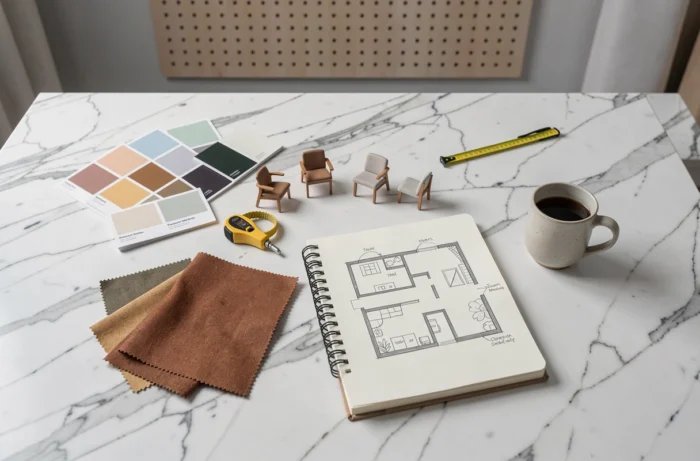
Take the example of a living room. A ceiling light diffuses uniform lighting. Add an adjustable floor lamp near the sofa for reading, then a table lamp on a low piece of furniture to warm up the atmosphere in the evening. The result changes radically without touching a single piece of furniture.
Why this choice of layering? Because light alters the perception of wall colors, the depth of a room, and even the comfort felt. A warm light (around 2,700 K) is suitable for the living room and bedroom, while neutral lighting (3,500-4,000 K) works better in a kitchen or office.
- Dimming switch: it allows you to transition from bright light during the day to a dimmed ambiance in the evening, without changing bulbs.
- Color rendering index (CRI): above 80, the shades of your decor appear true to life. Below that, a terracotta wall may seem dull.
- Spot orientation: grazing light on a textured wall (stone, brick, plaster) creates relief, while frontal lighting flattens it.
Textiles and Decorative Accessories: Pieces That Add Character
A gray sofa in a white living room remains neutral as long as nothing is placed on it. Textiles act as a binding element between furniture, walls, and floors. Cushions, throws, curtains, and rugs bring color, texture, and an immediate sense of comfort.
Start with the rug; it visually anchors the space. A rug that is too small under a coffee table makes the living room feel like it is floating. The simple rule: the front legs of the sofa and chairs should rest on the rug.
Curtains serve multiple functions. They filter light, provide thermal insulation, and visually elongate the room when fixed near the ceiling. Choose a rod placed above the window frame, not at the top of the glass.
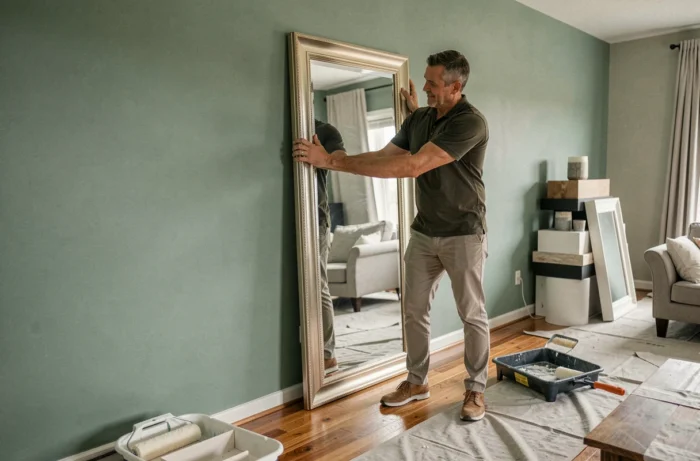
For cushions, limit yourself to three or four per seat. Beyond that, the accumulation hinders usage. Vary the sizes (one large, two medium) and mix materials (velvet, linen, textured cotton) while staying within a palette of two or three colors maximum.
Storage Furniture: Clearing Space to Decorate Better
A cluttered interior makes any decoration unreadable. Before thinking about style, think about storage. Closed storage furniture reduces visual noise and allows the objects you want to highlight to breathe.
Buffets, dressers, and glass-fronted bookcases fulfill this mission. A buffet in a dining room hides everyday dishes while providing a surface to display a vase or lamp. An open shelf, on the other hand, requires staging: alternate books, objects, and empty spaces to avoid a cluttered effect.
- The rule of thirds: on a shelf, leave one-third of the space empty. The void is part of the composition.
- Baskets and boxes: they structure open shelves, hide clutter, and add texture (wicker, fabric, metal).
- The entryway furniture: it’s the first impression. A bench with integrated storage or a narrow console with hooks is enough to organize this often-neglected space.
Reuse and Second-Hand: A Concrete Path but Still Not Standardized
A decree from February 21, 2024, plans for public acquisitions to gradually include a share of products from reuse, with a stated goal of 25% for furniture and interior fittings by 2030. This dynamic expands the offer of second-hand furniture and materials available for individuals.
However, reuse remains a minority. According to the ADEME overview dedicated to 2024, about 240,000 tons of products and materials have been reused, which is less than 1% of the total market. Sourcing second-hand can be interesting for pieces with strong personality (vintage dresser, antique light fixture), but it remains less predictable than buying new in terms of availability and dimensions.
Integrating one or two thrifted pieces into a decorative project adds character without turning logistics into a headache. The most effective approach: first define the structural furniture (sofa, bed, table) as new, then look for accessories and small accent furniture second-hand.
Each piece of an interior gains coherence when lighting, textiles, storage, and materials are considered together. A well-chosen piece of equipment from the start avoids costly corrections, and a critical eye on the composition of a room is as important as the budget allocated to it.