Paris is home to hundreds of parks, gardens and museums that welcome families, along with newer venues designed to combine free play, workshops and movement activities. From free municipal programs and indoor play spaces to school playgrounds open at weekends, there is far more on offer than the usual tourist attractions. This article explores practical options, highlighting what works for different ages and budgets.
Open school playgrounds and municipal sports: free family outings in Paris
Before considering a museum or theme park, there’s an underused local option. In the 18th arrondissement, some school playgrounds are open to the public on Saturdays from 10 a.m. to 5 p.m., except when closed for winter maintenance. Children under 12 must be accompanied by an adult.
This program turns a schoolyard into a neighborhood playground, with no booking or queues. For families living nearby, it’s an easy option when the weather is good enough to go out but there isn’t time to cross the city.
The Paris Sport Familles program adds to what’s on offer. It provides supervised sports activities for children aged 3–7 at weekends, with no advance booking required and places available on a first-come, first-served basis. Drop-in access, with no registration, removes the planning hurdle that often puts parents of young children off. These two municipal programs provide a free foundation, alongside other Parisian tips and deals listed in Le Paris des Lardons’ family section.
Indoor play spaces in Paris: Rêvopolie and venues for different age groups
Going out with a baby and an eight-year-old presents a practical challenge: few activities suit both at the same time. New indoor play spaces are trying to solve this problem.
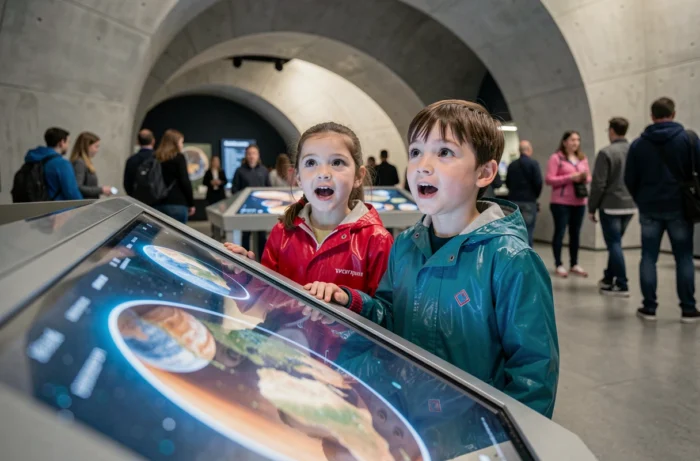
Rêvopolie, in the 15th arrondissement, offers imaginative play areas for children aged 0–10. The venue includes a dedicated movement area for babies, separate from the role-play zones for older children. Creative and music workshops round out the program. Visits are booked in two-hour sessions, and reservations are recommended.
These timed sessions have an advantage for parents: they set a clear end time, avoiding negotiations when it’s time to leave. Two hours also matches the attention span of a child under six in a stimulating environment.
The mini-city concept for children: full-scale role-play
Just outside Paris, some play spaces are built around the mini-city concept. Children take on roles such as shopkeeper, doctor or firefighter in settings scaled to their size. This kind of full-scale role-play develops language and social skills, while keeping children occupied long enough for parents to take a breather.
The main drawback is the admission price, which can add up for larger families. Prices vary by time slot and group size, making it difficult to compare without checking directly with each venue.
Outdoor activities in Paris: gardens, neighborhood walks and cooling spots
Parisian gardens remain the most obvious free place to play, but the way people use them is changing. Several parks now serve as cooling spots during heatwaves, with water fountains, shaded areas and, in some cases, misting systems.
For families, this practical feature makes a difference: in summer, choosing a garden with plenty of tree cover and water play areas makes it possible to get outside even in scorching weather. Parks along the Petite Ceinture or in the Belleville and Buttes-Chaumont neighborhoods offer more varied terrain and greenery than small gardens in the city center.
- Parc des Buttes-Chaumont (19th arrondissement) combines slopes, a grotto, a waterfall and large lawns, with playgrounds spread across several levels—ideal for children who love to explore.
- Jardin du Luxembourg (6th arrondissement) has model sailboats on the pond, a historic carousel and a paid but well-equipped play area for children under ten.
- Parc de Belleville (20th arrondissement) offers the clearest views of eastern Paris, with a terraced playground and a less touristy neighborhood feel.
- Jardin des Plantes (5th arrondissement) combines a visit to the Grande Galerie de l’Évolution (where the “On the Trail of the Dinosaurs” exhibition lets children aged six and up step into the shoes of paleontologists) with a botanical walk outdoors.
Family workshops and museum visits in Paris: what works for different ages
Parisian museums are offering more and more activities for children, but some are better than others. It’s worth distinguishing between a visit that is simply “child-friendly” and a genuinely hands-on workshop.
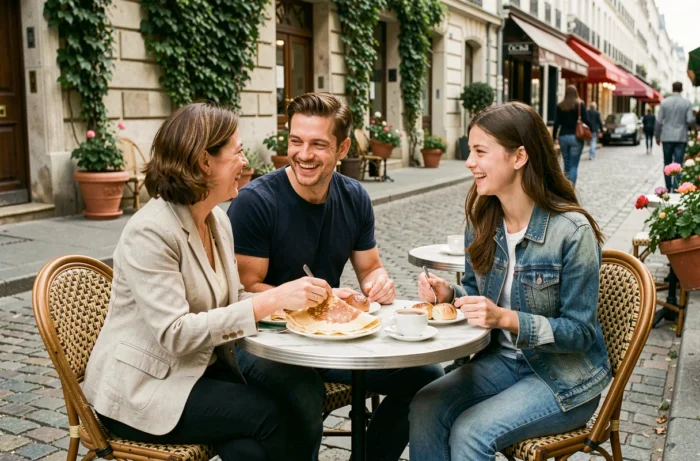
At the Cité des sciences (19th arrondissement), the “Critical Thinking: Come and Test Yourself” exhibition is a good example of an immersive, interactive family visit. Wearing a connected wristband, the whole family explores a recreated city and takes on challenges inspired by cognitive psychology. The visit ends with a personalized assessment. The format is suitable for children aged ten and up.
Other Parisian museums use hands-on, tactile activities to engage children aged three to eight, who may struggle to sit still in a traditional museum. At this age, learning through movement works better than simply listening to an audio guide.
Live performances: an alternative to screens for little ones
For younger children, live performances can be a more accessible introduction to culture than a museum. Several Parisian venues put on shows for very young audiences, with short running times (under an hour) and small audiences to avoid sensory overload.
These outings are affordable, often costing less than admission to a theme park, and can leave a lasting impression on children experiencing live performance for the first time.
Choosing a family outing in Paris depends less on the number of options available than on how well you can narrow them down by your children’s actual ages, an acceptable travel time and the day’s budget. Free options (school playgrounds, Paris Sport Familles and gardens) cover many everyday needs.
Paid venues such as Rêvopolie and the Cité des sciences are a good next step when you’re looking for a more structured experience. Checking access requirements and time slots before you set off is the only advice that’s genuinely useful.