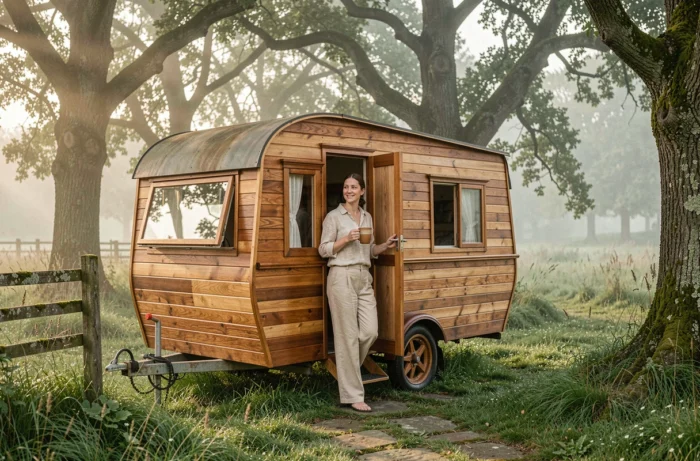
In the tourism industry, a roulotte is a wooden accommodation unit built on a chassis, inspired by the traditional homes of travelling communities. In France, the vast majority of stays in roulottes take place in units set up on a property and connected to water and electricity, without moving during the stay. This distinction between stationary and itinerant roulottes affects the comfort on offer, the regulatory framework and the type of experience guests can expect.
Stationary or itinerant roulotte: two very different nature experiences
The word “roulotte” naturally brings to mind travel, the open road and stopping along the way. The reality of the market is more nuanced. Almost all unusual accommodation offers in roulottes involve units permanently installed on an estate, campsite or nature reserve.
A stationary roulotte offers comfort similar to that of a compact holiday cottage: quality bedding, a well-equipped kitchenette and sometimes a wood-burning stove. It stays in one place, but its setting in the heart of nature (at the edge of a forest, in a meadow or by a river) offers a genuine change of scenery without the logistical hassle.
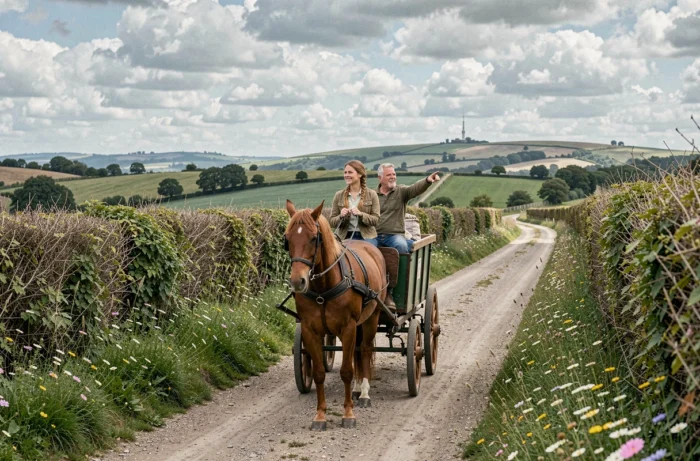
An itinerant stay, on the other hand, involves a roulotte pulled by a horse or vehicle, with planned stops along the way. This type of trip is still rare in France. It requires advance planning to find water points, authorised stopping places and suitable accommodation at each location along the route. Organising such trips with Dormir En Roulotte gives you access to a mapped-out itinerary and partnerships with private landowners.
The choice between the two options depends above all on how much independence you want. Families with young children often prefer a stationary roulotte. Couples looking for freedom and spontaneity may opt for an itinerant trip, provided they are prepared for more basic comfort.
Comfort in a roulotte: what accommodation really offers
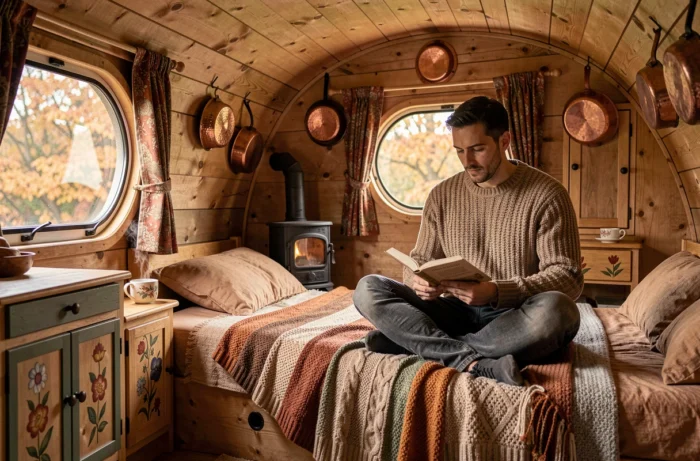
The interior of a roulotte used for accommodation is a far cry from the spartan image you might have of it. Like a boat, the space is cleverly designed to make the most of every centimetre.
The living area rarely exceeds the size of a large bedroom, but the layout makes up for it. Most have a double bed (sometimes raised, with storage underneath), a convertible bench seat, a water point and additional lighting. Some properties also provide private bathroom facilities in an adjoining building.
The charm comes from the materials: wood panelling, thick fabrics and warm colours. The quality of the finishes varies considerably from one place to another. Before booking a night in a roulotte, it’s worth checking a few things:
- Whether private bathroom facilities (shower and toilet) are available, either inside the roulotte or in a separate building nearby
- What type of heating is available, especially for an off-season stay (wood-burning stove, portable electric heater or none)
- Whether the site is accessible to people with reduced mobility, as roulottes often have a narrow staircase and raised floor
- The actual distance between the roulotte and the other accommodation on the property, which determines how much privacy you’ll have
The comfort of a roulotte getaway depends less on the amenities than on the setting. A secluded spot with open views and peace and quiet can turn a night in a small space into a memorable experience.
Legal status of a roulotte: an important point to consider
The term “unusual accommodation” has no single legal definition. The applicable rules depend on how mobile the structure actually is and whether it is connected to utility networks. A roulotte that still has its wheels but has remained fixed to the ground for years may be subject to different planning rules from a genuinely movable structure.
For travellers, this has practical implications. A property that operates roulottes as tourist accommodation will generally need to comply with the requirements for establishments open to the public. Fire safety, accessibility and insurance rules apply according to the establishment’s declared status.
Checking that the property is registered as tourist accommodation before booking can help protect you in the event of a dispute or incident. A property listed with the local tourist office or holding a registration number issued by the town hall offers a basic level of reassurance. The label “roulotte” or “cabin” alone does not determine the legal framework: what matters is where the structure is installed and how it is used.
Family stays in a roulotte: what works and what doesn’t
Families are drawn to roulottes for their cabin-like feel, woodsy atmosphere and the promise of an out-of-the-ordinary night. Children love the cosy, enclosed space, the little nooks and the feeling of sleeping “outdoors”.
But the drawbacks quickly become apparent if the layout isn’t suitable. Limited space makes stays of more than two nights difficult for families with more than two children. Storage is minimal, bathroom facilities may be some distance away, and soundproofing between neighbouring roulottes varies considerably.
A successful family stay comes down to a few simple things: choose a property with nearby outdoor activities (trails, farm animals, swimming), limit your stay to two or three nights to keep the experience fresh, and check the actual sleeping capacity. A roulotte advertised for four people may prove uncomfortable if two of the beds are narrow bench seats.
Properties best suited to families often offer several types of unusual accommodation (roulotte, cabin, yurt) on the same site. This makes it possible to try different experiences during a longer stay, without the space constraints of spending several days in a single roulotte.
Roulottes remain one of the most affordable and widely available types of unusual accommodation in France. Their appeal lies in the balance they offer: enough comfort for a good night’s sleep, and a simple enough setting to make you feel somewhere else. The main pitfall is expecting the same standards as a conventional hotel. A roulotte stay works best when you embrace its limitations as part of the getaway.