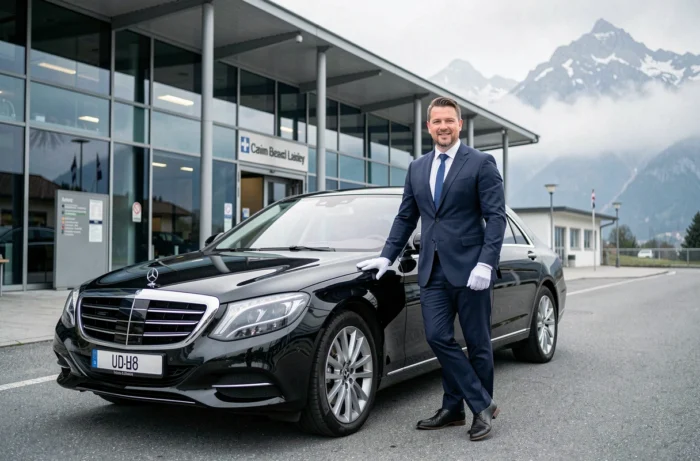
Switzerland concentrates a dense transport network within a compact territory, among the most extensive in Europe. For journeys that fall outside the railway framework or regional bus lines, the use of a private taxi or a premium transfer service remains the norm. This is particularly true on routes connecting airports to alpine resorts and business centers.
The Swiss regulatory framework, recently supplemented by new provisions on automated driving and electric utility vehicles, outlines a changing mobility landscape. The private driver retains a central role in this context.
Automated Driving in Switzerland: Why the Private Driver Remains the Norm
The Ordinance on Automated Driving (VAF), in effect since March 1, 2025, theoretically allows the operation of driverless vehicles in defined areas approved by the cantons, under the supervision of an operator. The text establishes a framework, not an operational reality.
To date, no operational area has been approved for a commercial robotaxi service in Switzerland. All projects remain at the pilot stage. For anyone booking an airport transfer or a VIP journey, this concretely means that private transfers are strictly provided by human drivers.
The marketing of certain mobility platforms suggests a rapid transition to automation. Field feedback varies. Swiss prestige transport operators do not foresee a shift for several years, due to the lack of approved zones and certified vehicles for this type of service.
The service relies on the driver’s experience, knowledge of alpine roads, and ability to adapt the route in real-time, a parameter that automation does not yet cover.
Providers operating between Geneva, Zurich, the Alps, and neighboring French cities, such as those listed on yvazur.ch, continue to structure their offerings around qualified drivers and premium fleets.

Electric Fleets and VIP Transfers: What Swiss Regulations Change
The Federal Council has taken measures to enhance the attractiveness of electric delivery vehicles by aligning the rules applicable to electric utility vehicles with those for thermal models. For premium private transfer services in high-end vans (Mercedes V-Class, VIP minibuses), this evolution paves the way for broader adoption of electric vehicles without excessive regulatory constraints.
The direct impact on the prestige segment is twofold:
- Operators can integrate electric vans into their fleet without administrative costs related to weight or size exemptions, facilitating fleet renewal.
- Airport trips to ski resorts or urban centers benefit from an additional argument for clients sensitive to the environmental footprint of their travels.
- Manufacturers positioned in the luxury segment, such as Denza (a subsidiary of BYD), which has launched its entry into the Swiss market with high-end hybrid and electric models, now provide credible alternatives to traditional thermal sedans.
The available data does not allow for conclusions about the actual share of electric vehicles in private transfer fleets in Switzerland. However, the regulatory framework is no longer a barrier to their deployment.
International Transport from Switzerland: New Obligations for Transfer Fleets
Since May 1, 2025, new licensing and fleet management obligations apply to international traffic. This development concerns VIP minibuses and vans used for cross-border transfers, particularly on routes such as Geneva-Lyon, Geneva-Chamonix, or Zurich-Milan.
For passengers, this change remains invisible. For operators, it imposes an administrative compliance requirement that mechanically filters out non-professional market players. Providers holding international licenses offer a guarantee of compliance that general booking platforms do not systematically verify.
What This Means for a Cross-Border Journey
A private transfer from Geneva Airport to a French resort (Chamonix, Megève, Les Gets) or to Lyon involves crossing a border. The vehicle must have a valid international transport authorization. Drivers must be able to present licensing documents at any customs check.
This requirement is not trivial. Checks on the Franco-Swiss routes have intensified in recent years, and a non-compliant operator exposes their passengers to delays or even interruption of the journey. Verifying that the provider holds an international transport license is as relevant a selection criterion as the type of vehicle or the displayed rate.

Selection Criteria for a Private Taxi Service in Switzerland
The Swiss private transfer market does not have a central aggregator comparable to what exists for hotels. Booking is done through direct contact with the operator or via specialized platforms. This system makes comparison less immediate but allows for a level of service personalization that standardized ride-hailing apps do not offer.
- License and Regulatory Compliance: Verify that the operator has the necessary cantonal authorizations and, for cross-border journeys, a valid international license.
- Fleet Composition: A provider that lists the specific models of their vehicles (sedan, van, minibus) and their year of registration gives an indicator of transparency.
- Real-Time Flight Tracking: For airport transfers, the driver’s ability to adjust the pickup time based on flight delays avoids unnecessary waiting times.
- Multilingual Drivers: In a market where four national languages coexist with an international clientele, the driver’s language proficiency is not a cosmetic detail.
The high-end segment is distinguished less by price than by the reliability of the pickup and the ability to manage unforeseen circumstances. A transfer from Zurich to Davos in mid-winter, with changing road conditions, requires expertise that only an experienced driver and an appropriate vehicle can guarantee.
Swiss regulations, by tightening licensing requirements and facilitating the adoption of electric fleets, push the market towards increased professionalization. For travelers, this translates into a more uniform level of service, but also into the necessity to distinguish truly compliant operators from those operating outside the legal framework.