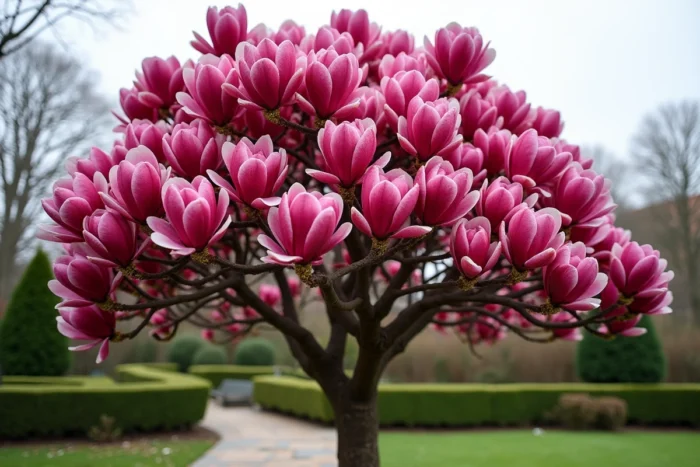
The Magnolia ‘Vulcan’ produces massive flowers of a deep purple-red that appear before the foliage. This spring spectacle is captivating, but it comes with a fragility that many gardeners discover too late. A hybrid resulting from the cross between Magnolia campbellii and Magnolia liliiflora, ‘Vulcan’ begins its blooming very early in the season, which directly exposes it to the climatic uncertainties of late winter.
Location of the Vulcan Magnolia: the factor that determines everything else
Before discussing soil or watering, it is the choice of location that determines success or failure. The flower buds of ‘Vulcan’ swell early, sometimes as early as the end of February. One late frost is enough to ruin the entire bloom.
Have you ever seen a magnolia covered in brown, soft flowers that fell within hours? This is exactly what happens when a young specimen is planted in a drafty spot. The solution is to choose a wall facing south or west, an inner courtyard, or a slope naturally protected from cold winds.
The idea is not to confine it but to offer it a microclimate. A stone wall that radiates the heat accumulated during the day creates a sufficient temperature difference to protect the buds during freezing nights. Specialized nurserymen also recommend placing a winter cover as soon as the buds swell, monitoring the weather from late March to early April.
To delve into each step, from planting to seasonal maintenance, the cultivation of the Vulcan magnolia on Conseil Jardinage details the appropriate actions for this hybrid.
Acidic soil and drainage: preparing the soil for a magnolia in the ground
The Magnolia ‘Vulcan’ grows in acidic to neutral soil. A pH above 7.5 causes chlorosis, those leaves that yellow between the veins. Before planting, a simple pH test at the garden center is enough to clarify any doubts.
Creating a suitable substrate without excavating everything
There is no need to replace all the garden soil. The most effective method is to dig a wide hole (at least twice the volume of the root ball) and mix the extracted soil with heather soil and well-decomposed compost. This mixture lowers the pH locally and improves drainage.
A soil that retains stagnant water in winter kills the fleshy roots of the magnolia. If your land is clayey and compact, place a layer of gravel or pumice at the bottom of the planting hole. The roots of ‘Vulcan’ are shallow but spread out: they need loose soil over a wide area rather than deep down.
Mulching: protecting without suffocating
A mulch of pine bark or shredded dead leaves maintains soil acidity and limits evaporation. Spread it to a reasonable thickness around the base, keeping a few centimeters of space between the mulch and the trunk to avoid collar rot.
Pruning the Vulcan Magnolia: the less you prune, the better it thrives
This is a point that many gardeners accustomed to classic shrubs find hard to accept. The Magnolia ‘Vulcan’ heals slowly. Each significant cut represents an entry point for pathogenic fungi.
Pruning is limited to the strict necessary: dead wood, crossing branches, poorly placed suckers. Prune just after flowering, when the sap is actively flowing and healing is fastest. Pruning in autumn or winter slows down wound closure and exposes the tree to infections.
- Remove dead or frost-damaged branches by cutting them flush with a healthy shoot, leaving no stubs.
- Remove branches that grow inward in the crown and prevent light from reaching the center of the tree.
- Never shorten the main branches: ‘Vulcan’ naturally forms an upright shape that rounds out with age; any severe cut distorts the silhouette.
- Disinfect your pruners with alcohol between each cut to limit disease transmission.

Watering and fertilization through the seasons
The Vulcan magnolia requires moist soil but never waterlogged. In summer, during prolonged dry spells, a thorough watering once or twice a week is better than small daily amounts. The water must penetrate deeply to encourage the roots to go down.
Fertilizer: feeding without burning
In spring, a surface application of mature compost is usually sufficient. If growth seems weak or the foliage lacks color, a fertilizer for heather plants provides the necessary supplement.
- Apply the fertilizer in early spring, before the leaves start to bud.
- Never fertilize after mid-summer: a late shoot does not harden before winter and freezes.
- Prefer slow-release formulations to avoid a spike in mineral salts that burns the surface roots.
Powdery mildew and summer vigilance
In warm, humid weather, powdery mildew can appear as a white fluff on the leaves. Airing out the crown with light thinning (always after flowering) reduces the risk. Avoid overhead watering on the foliage, which encourages spore development.
The Magnolia ‘Vulcan’ is not a difficult tree, but it is demanding in its early years. A well-chosen location, properly prepared soil, and minimal pruning give it the conditions to establish itself sustainably. Once past this stage, it gains hardiness and rewards every spring with a bloom that few garden trees can rival.