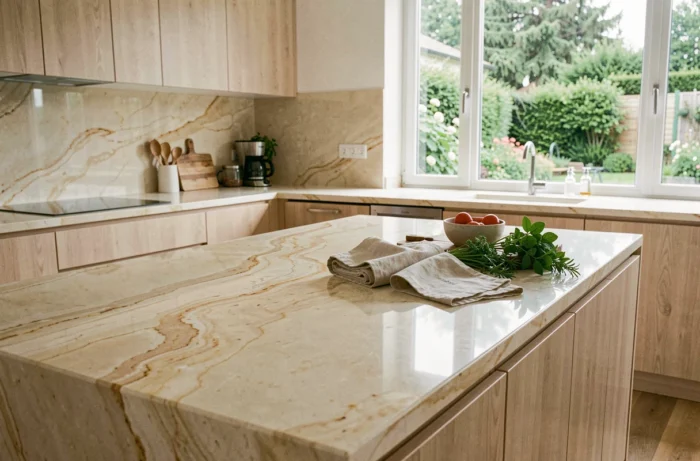
Galala marble is a crystallized limestone extracted from Egyptian quarries, recognizable by its light beige hue marked with subtle veining. In Morbihan, where interior and exterior renovation projects are multiplying, this natural stone is generating increasing interest. Several factors explain this growing position: a pricing strategy more accessible than Italian marbles, a warm color palette, and versatility of use ranging from countertops to terrace paving.
Galala marble outdoors: an underestimated resistance to the Breton climate
Most content on Galala emphasizes its decorative qualities indoors. Its use outdoors is rarely documented, even though this stone has interesting technical characteristics for a region subjected to humidity and temperature variations like Morbihan.
Galala has relatively low porosity for a marble. When combined with an appropriate water-repellent treatment, it withstands freeze-thaw cycles better than some marbles with a more open grain. Field reports vary on this point depending on the finishes chosen: a brushed or honed Galala withstands the elements better than a polished Galala, whose smooth surface can become slippery.
For terraces, pool copings, and outdoor stairs near Vannes, the non-slip finish remains the most coherent choice. Regular surface treatment (every two to three years depending on exposure) extends the lifespan of the covering without altering its natural hue. The advantages of Galala marble also lie in its ability to adapt to local climatic constraints.
Galala versus travertine and sandstone: comparison for a renovation project
Travertine and sandstone are among the natural stones most frequently compared to Galala in renovation projects. Each has distinct advantages depending on the intended use.
| Criterion | Galala Marble | Travertine | Sandstone |
|---|---|---|---|
| Dominant hue | Light beige, fine veining | Beige to hazelnut, natural cavities | Gray, ochre, brown depending on origin |
| Porosity | Moderate | High (requires filling) | Low to very low |
| Indoor floor use | Living room, bathroom, kitchen | Living room, entrance | All rooms |
| Outdoor use | Terrace, coping (brushed finish) | Terrace, pool deck | Terrace, pathway |
| Maintenance | Periodic water-repellent treatment, pH-neutral product | Initial filling, water-repellent | Simple cleaning, low maintenance |
| Price positioning | Intermediate | Accessible | Variable depending on quality |
Galala stands out for its natural brightness that travertine does not offer due to its cavities. Sandstone, being more scratch-resistant, lacks the visual warmth characteristic of beige marbles. For a bathroom or countertop, Galala represents a compromise between the elegance of marble and adequate mechanical resistance.
However, for high-traffic areas (entrance hall, commercial space), sandstone is more suitable. The choice primarily depends on the room’s purpose and the intensity of use.
Trend of beige marbles in interior renovation: why Galala is gaining ground
Recent trends in flooring and interior design show a growing demand for warm-hued marbles in large formats. Renovation projects now favor the authenticity of the vein and natural variations over a uniform white.
Galala fits into this movement. Its sandy hue, slightly clouded, brings a bright atmosphere without the coldness sometimes attributed to white marbles like Carrara or Calacatta. In a house near the Vannes coastline, where natural light varies with the seasons, this chromatic warmth compensates for gray days.
Interior architects use Galala in several configurations:
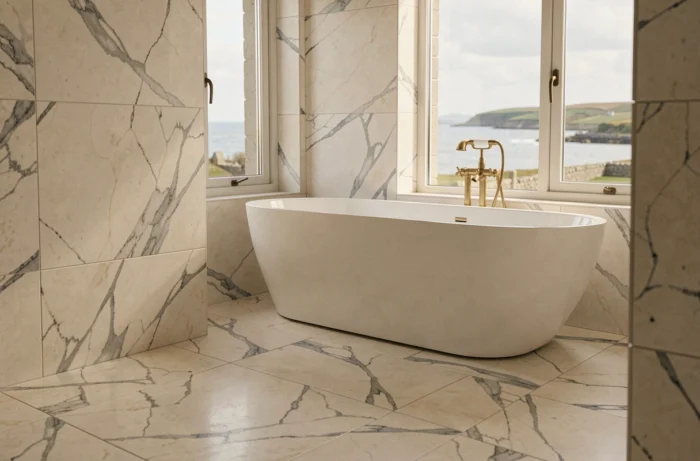
- Bathroom wall covering with large format slabs, to create a visual continuity without visible joints
- Kitchen countertop paired with light wood cabinetry, in a logic of natural materials
- Living room floor laid straight or in herringbone, with a visual enlarging effect thanks to the reflection of light on the polished surface
Galala works well in both complete renovations and as an accent (backsplash, shower niche, window sill). This versatility partly explains its growing popularity in residential projects in Morbihan.
Maintenance of Galala marble: what product sheets do not specify
Commercial sheets often present Galala as an easy-to-maintain stone. The reality requires some clarifications.
Like all marble, Galala is sensitive to acids. Lemon juice, an aggressive cleaning product, or a classic descaler can leave a dull mark on the polished surface. Daily cleaning should be done exclusively with a pH-neutral product, diluted in warm water.
The initial waterproofing is a step that many individuals overlook. An oil-repellent water-repellent applied after installation protects the stone from grease and moisture stains. This treatment should be renewed according to use: more frequently in a kitchen than in a living room.
- Apply an oil-repellent water-repellent as soon as it is installed, before first use
- Clean with a pH-neutral soap, without vinegar or acidic products
- Renew the protective treatment every two to three years indoors, more often outdoors
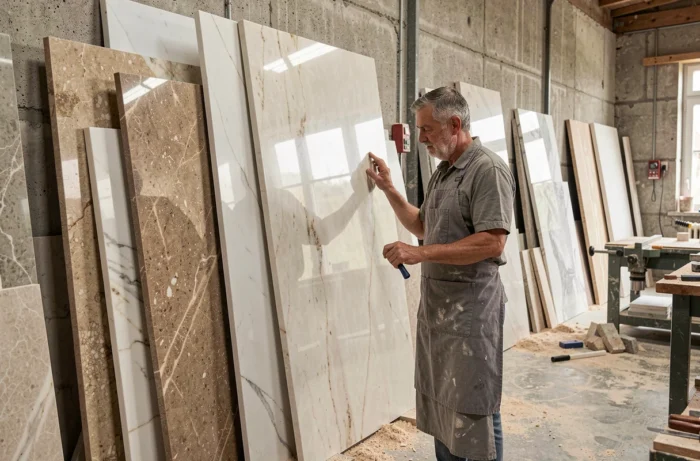
- Sand and re-polish locally in case of deep scratches, a task that can be performed by a professional marble worker
A well-maintained Galala retains its shine for decades. The longevity of this natural stone exceeds that of most ceramic tiles, provided these maintenance constraints are respected.
Galala marble remains a natural stone, with the qualities and limitations that this implies. For a renovation project near Vannes, it offers a balance between warm aesthetics, adaptability to local climatic conditions, and controlled costs compared to Italian marbles. The choice of finish and the rigor of maintenance will make the difference between a covering that ages well and a disappointing investment.