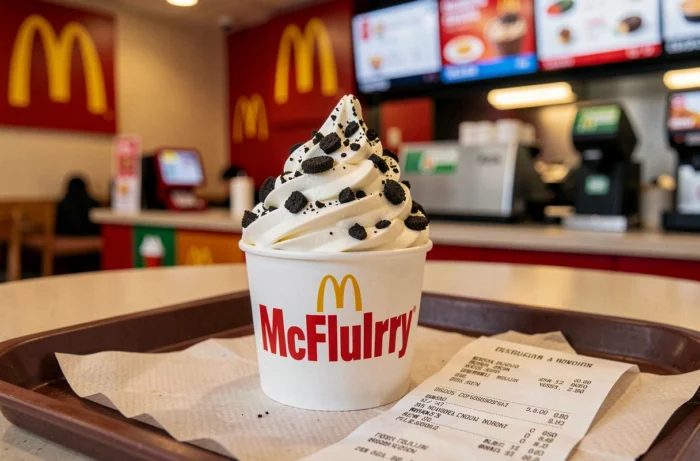
In front of a self-service kiosk, we often hesitate between the classic McFlurry and its equivalent at the competition. The displayed price varies depending on the brand, the restaurant, and even the ordering channel. In 2026, comparing the McFlurry at McDonald’s, Burger King, and Quick requires looking beyond the price shown on the national menu.
Price Differences Between Counter, Delivery, and Premium Areas
The most common trap in a comparison of fast-food ice cream desserts is relying on the catalog price. In 2026, the price of the McFlurry varies significantly depending on the ordering channel. At the counter of a provincial restaurant, you pay considerably less than at a sales point located in a train station, airport, or downtown Paris.
Locations deemed “premium” apply specific pricing grids, which are higher compared to standard restaurants. This phenomenon affects all three brands, but it is particularly noticeable at McDonald’s, where the density of the network multiplies configurations.
When ordering through a delivery platform, the bill rises even more. For example, an Original Mix & Match McFlurry was noted at 4.99 euros for delivery in Berlin, which is significantly more than the usual counter price. In France, the logic is the same: price increases are easily observed when analyzing the price of the McFlurry at Burger King or at McDonald’s via delivery apps compared to an in-store order.
To compare fairly, you must therefore reason with the same channel:
- Counter price in a provincial restaurant, without area surcharge
- Counter price in a major metropolitan area or premium location (train station, airport, Champs-Élysées)
- Delivery price via Uber Eats, Deliveroo, or the brand’s own app, which includes service fees and platform margin
Without this framework, any comparison remains approximate.

McFlurry McDonald’s, King Fusion, Quick Sundae: What We Really Compare
We often refer to “McFlurry” as a generic term, but each brand names and formats its ice cream dessert differently. At McDonald’s, the McFlurry comes in a standard version and limited editions that change several times a year. Limited editions always cost more than the permanent recipe.
At Burger King, the equivalent is called King Fusion. The format, weight, and toppings differ. Comparing an Oreo McFlurry and an Oreo King Fusion does not equate to comparing two identical products: the amount of ice cream, the ratio of toppings, and the size of the container vary.
Quick, for its part, offers ice cream desserts under different names. The Quick network is smaller in France than McDonald’s or Burger King, so price feedback is less uniform. Quick’s pricing grids follow a logic comparable to its competitors, with local variations, but the range of ice cream desserts is generally narrower.
Permanent Recipe vs. Limited Edition
This is a point that comparisons often overlook. A limited edition can cost significantly more than a classic McFlurry, sometimes with a difference of over one euro. If we compare the cheapest dessert from each brand, the ranking can reverse compared to a comparison of seasonal novelties.
Before concluding that one brand is “cheaper,” you must ensure that you are comparing the same product category: permanent recipe against permanent recipe, limited edition against limited edition.
Why the McFlurry Became a Premium Product in 2026
Since 2025, the positioning of the McFlurry has changed. It is no longer the entry-level dessert that one mechanically adds to their menu. The McFlurry is now clearly positioned as a premium dessert at McDonald’s, with brand collaborations (KitKat, Daim, Oreo) and special formats.
This upgrade is reflected in significant price differences between restaurants of the same chain. Two McDonald’s locations in the same city can display different prices for the same McFlurry, depending on their location and local policy.
Burger King and Quick Follow the Same Logic
The phenomenon is not limited to McDonald’s. Burger King has also enriched its ice cream dessert menu with more elaborate recipes, and prices have followed suit. Quick, while less aggressive in seasonal launches, also adjusts its prices upward on desserts.
The result for the consumer: the gap between brands is often smaller than the gap within the same brand depending on the location and ordering method. In other words, the choice of restaurant sometimes matters more than the choice of brand.

Summary Table: Comparison Criteria for McFlurry, King Fusion, Quick Dessert
| Criterion | McDonald’s (McFlurry) | Burger King (King Fusion) | Quick |
|---|---|---|---|
| Permanent Range | Large (several flavors) | Medium | Narrow |
| Limited Editions | Frequent, price increase | Regular | Occasional |
| Local Price Variability | High (premium areas) | Moderate | Moderate |
| Delivery Surcharge | Marked | Marked | Variable depending on the network |
| Number of Outlets in France | The most dense | Intermediate | The most restricted |
This table does not provide fixed prices, and this is intentional. Displaying a unique price per brand would be misleading given the range of differences observed in 2026. The most reliable approach is to check the price on each brand’s app, selecting the restaurant where you plan to order.
One last point to keep in mind: promotions via mobile apps (McDeal at McDonald’s, King Junior offers or coupons at Burger King) can shift the value-for-money ratio from one brand to another from week to week. Consulting the app before ordering remains the most cost-effective reflex.