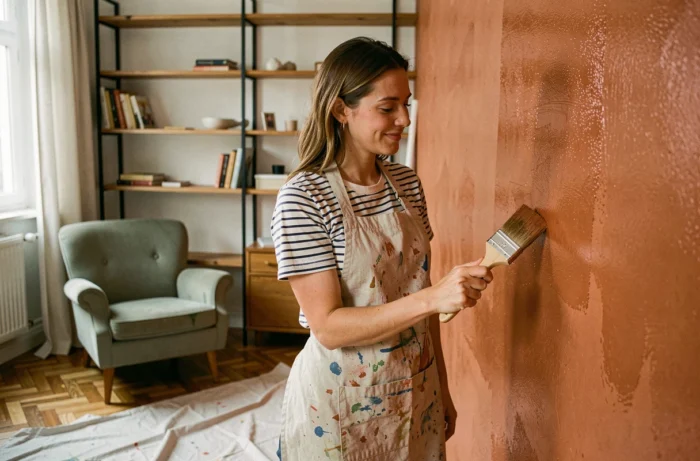
The wall palette and furniture are no longer enough to qualify a successful transformation. For the past two years, interior decoration projects have integrated technical parameters (color temperature, acoustics, air circulation) that radically change the perceived comfort without heavy renovations. Here, we offer concrete levers, often overlooked by general guides, to transform and decorate your home with a lasting result.
Color Temperature and Color Rendering Index: Lighting as a Transformation Tool
A change of light fixture produces no measurable effect if the source remains the same. We recommend thinking in terms of color temperature (expressed in kelvins) rather than the design of the fixture. A living room gains comfort with sources between 2,700 K and 3,000 K, while a kitchen worktop requires at least 4,000 K for accurate food rendering.
The other underestimated parameter is the color rendering index (CRI). A CRI below 80 distorts wall shades, negating the effort put into the paint. Recent LED bulbs achieve a CRI of 90 and above, at a cost comparable to low-end models.
Multiplying light points remains a relevant piece of advice, provided they are distributed across at least three levels: indirect ceiling light, task lighting, and accent light on the floor or on an object. This layering creates a visual depth that enlarges the perceived space without touching a single wall. Several ideas and practical sheets are compiled on the site bricodeco-home.fr, which covers both lighting and furniture.
Wall Palettes 2025-2026: Deep Greens and Earthy Tones Replacing Gray
The underlying trend is clear: neutral grays are giving way to deep greens and earthy tones. Sage green, olive, forest, as well as cream, beige, and taupe are becoming prominent in residential projects focused on well-being. This shift is not just aesthetic. These shades, associated with the warm minimalism movement, explicitly aim to reduce mental load in living spaces.
Applying a deep green on a single wall (the wall behind the sofa or the one facing the room’s entrance) is enough to visually restructure a living room. The technical rule: the strong color goes on the shortest wall to elongate the perception of the room, or on the wall farthest from the window to absorb the low light without darkening the whole.
Combining Color and Natural Materials
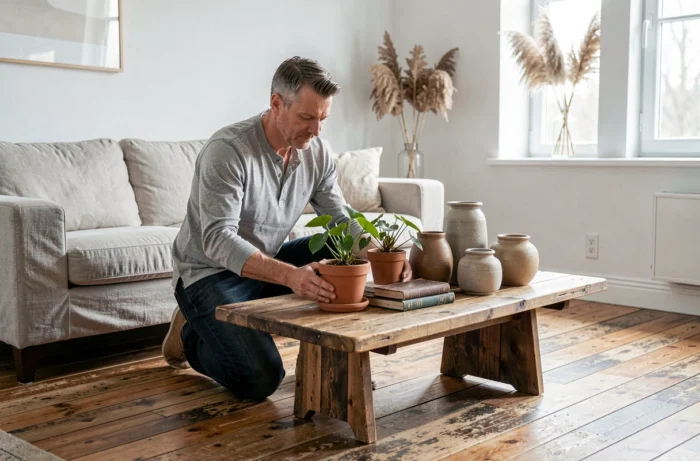
An olive green wall loses its effect if the surrounding furniture remains white melamine. The most successful projects combine color with raw wood, linen, or terracotta. This principle of quiet luxury applied to interior decor involves reducing the number of objects while upgrading the materials.
Replacing five decorative accessories with a single handcrafted object in stoneware or turned wood creates a clearer visual impact.
Space Optimization Without Additional Furniture
Adding a piece of furniture to an already cluttered room solves nothing. Transformation begins with subtraction. We recommend a simple protocol before any purchase:
- Remove all objects from horizontal surfaces (consoles, shelves, worktops) and only reintroduce those that serve a function or provoke an identified emotion.
- Move the largest piece of furniture in the room to another wall, ensuring at least 80 cm of circulation around passage areas.
- Remove a storage unit and redistribute its contents into existing closed storage: a visually emptied space enlarges the room more than a mirror.
This approach directly aligns with warm minimalism: fewer objects, but better chosen, with organic shapes (rounded, asymmetrical) that soften the overall ambiance.
Textiles and Acoustics: The Most Underestimated Decor Lever
Changing textiles modifies a room’s acoustics as much as its appearance. A tiled living room with a leather sofa resonates. Adding a thick short-pile rug, linen cushions, and heavy fabric curtains (corduroy, thick cotton) noticeably lowers the reverberation time. The resulting sound comfort transforms the overall perception of the room, far beyond mere visual aspects.
In practice, three textile elements are sufficient to change the atmosphere of a living room or bedroom:
- A throw for the sofa or bed in a color that contrasts with the furniture (raw linen on dark leather, terracotta cotton on gray fabric).
- Curtains that reach the floor, fixed as close to the ceiling as possible, visually elongating the ceiling height.
- A rug sized to extend beyond the sofa frame by at least 30 cm on each side, to define a coherent living area.
Textile Budget vs. Furniture Budget
Replacing a sofa costs several hundred euros at minimum. Replacing all textiles in a living room (rug, cushions, curtains, throw) represents a fraction of that amount for a comparable visual impact. Textiles are the decor lever with the best transformation/budget ratio.
Energy Renovation and Decoration: A Crossroad to Anticipate
Since January 1, 2025, homes classified G in the energy performance diagnosis (DPE) are banned from rental. This regulatory constraint pushes many owners to undertake insulation work that disrupts the interior layout: wall lining (loss of living space), window replacement (modification of frames and curtains), addition of mechanical ventilation (visible grilles).
Anticipating decoration alongside energy renovation avoids redoing finishes twice. Specifically, choosing a tinted coating on insulating lining eliminates the need for a subsequent layer of paint. Similarly, opting for joinery with a slim profile increases the influx of natural light, a central parameter of the warm minimalism mentioned earlier.
Transforming your home in 2025-2026 is no longer just about choosing a wall color or a new piece of furniture. The most effective projects intersect technical lighting, a coherent color palette, textile management, and, when the context allows, anticipation of energy constraints. Three or four targeted interventions on these levers produce a more significant result than a dozen small decorative additions scattered throughout.