
The Renault technical sheet states that the Trafic L1H1 has a usable floor length of 2,537 mm, a width of 1,662 mm, and a height of 1,387 mm. These dimensions correspond to a bare chassis, without a wooden floor, insulation, or side panels. Working on a layout based solely on these values guarantees unpleasant surprises during assembly.
Discrepancy between catalog dimensions and actually usable dimensions of the Trafic L1H1
We consistently observe a gap between the manufacturer’s dimensions and the reality of a fitted cargo area. Data from rental companies and dealers confirm that a recent Trafic L1H1 offers rather 2,350 mm of usable length, 1,620 mm of width, and 1,400 mm of height once the vehicle is equipped with its original coverings.
The discrepancy arises from several cumulative thicknesses. The standard wooden floor adds a few millimeters in height but reduces usable height. The wheel arches, often underestimated, reduce the ground width to about 1,260 mm between the two bulges. And the bulkhead separating the cabin, depending on its model (solid sheet metal, grating, glass), takes away between 30 and 80 mm from the total length.
Before ordering a module or cutting a panel, you must take your own measurements on the exact vehicle you will be fitting. Two Trafic L1H1s from different model years do not necessarily share the same body tolerances.
To avoid common pitfalls during this measurement process, a detailed guide lists the interior dimensions of the Renault Trafic L1H1 and frequent errors that compromise a fitting.

Critical measurement points for a van conversion on Trafic L1H1
Taking a tape measure and recording length, width, and height is not enough. The cargo area of the Trafic L1H1 is not a rectangular prism: the sides are curved, the floor has ribs, and the ceiling arches towards the edges. We recommend working with at least seven distinct measurement points.
- Width at the floor between wheel arches: this is the most restrictive dimension, determining the maximum width of a low cabinet or a transverse bed. It is significantly below the maximum width stated between the walls.
- Width at mid-height (about 700 mm from the ground): this dimension, more generous, determines the feasibility of a worktop or a suspended storage box. The curvature of the walls offers a few extra centimeters here.
- Height under the ceiling after insulation: if you install insulation such as armaflex or cork of 19 mm on the ceiling, followed by a paneling, you easily lose 30 to 40 mm. With the initial 1,387 mm (bare chassis), the margin for a standing adult remains tight.
- Usable length behind the bulkhead to the threshold of the rear doors: the catalog value does not take into account the possible retraction of the door seal or the swing of the hinges.
Each measurement must be taken on the left and right. An asymmetry of a few millimeters is normal on a production vehicle, but it can become a problem on furniture adjusted to the millimeter.
Wheel arches and floor constraints
The wheel arches of the Trafic L1H1 rise about 200 mm above the floor and extend sufficiently to condition the positioning of a fixed bed or storage box. We recommend tracing their exact outline on a cardboard template before any panel cutting.
The floor also has longitudinal ribs. If you lay a leveling plywood, plan for shims or battens to compensate for these irregularities. A poorly supported floor transmits vibrations to the furniture and causes squeaks while driving.
Optimize the usable volume of the Trafic L1H1 without a solid bulkhead
The bulkhead separating the cabin is the first area for gaining length. Replacing a solid sheet metal bulkhead with a thinner grating bulkhead, or removing it entirely if the vehicle is no longer used in utility configuration, frees up several precious centimeters.
On a Trafic L1H1 converted into a camper van, removing the bulkhead often allows for fitting a longitudinal bed of 1,850 to 1,900 mm by utilizing the space above the folded front seats. Without this modification, the floor length limits a transverse sleeping area to the width between the wheel arches, which is about 1,260 mm, insufficient for most sleepers.
Warning: removing the bulkhead on a vehicle still registered as a CTTE (commercial vehicle) may raise homologation issues. Check the regulatory framework applicable to your situation before proceeding.
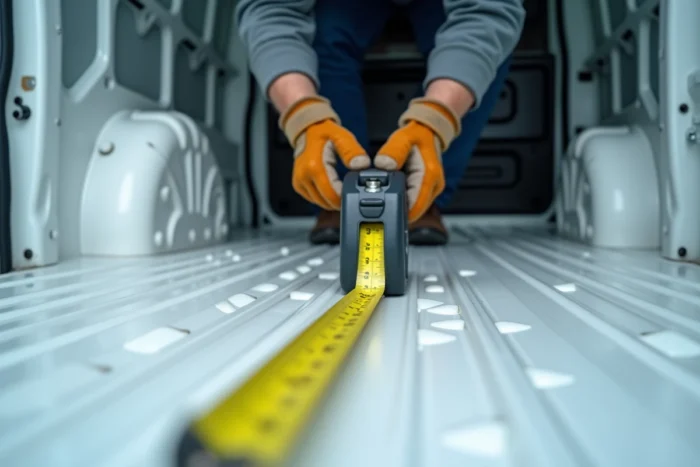
Templates and measurements: field method for the Renault Trafic
We use a simple method that avoids most reporting errors. It involves making rigid cardboard templates to the target dimensions of each module (bed, kitchen unit, storage box), and then physically positioning them in the vehicle before any fabrication.
- Cut out a template for each main element of your layout plan. Indicate the nominal dimension and the accepted tolerance on it (generally 5 mm of play on each side).
- Simultaneously position the templates in the van. A single piece of furniture may fit, but the combination of all modules can create invisible interferences on a 2D plan.
- Check the opening of the side and rear doors with the templates in place. A drawer or a shelf that prevents the complete closure of the sliding door is a common defect on the Trafic L1H1.
This step adds half a day to the project, but it eliminates costly rework in time and materials. A plywood panel cut too short cannot be compensated for.
Measurement tools suited to the curvature of the walls
A standard tape measure does not accurately reproduce the curve of a wall. For the curved profiles of the Trafic, a contour gauge (profile comb) or a flexible template made of corrugated cardboard provides a much more reliable outline. Laser measurements, reliable in length and diagonal, do not capture lateral curves.
The most reliable measurement combines a laser rangefinder for long distances (length, diagonals) and a contour gauge for curved sections (wheel arches, wall curvature, ceiling arch). This dual approach eliminates the majority of dimension discrepancies observed between the plan and the final assembly.
A successful layout in a Trafic L1H1 relies less on the choice of materials or furniture than on the precision of the initial measurements. The few centimeters lost between the manufacturer’s specifications and the reality of the vehicle are enough to render a module unusable. Measure twice, cut once remains the most cost-effective rule of the project.