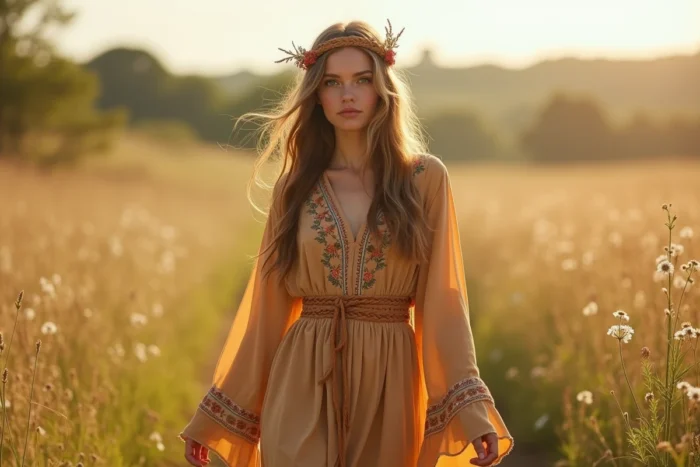
The return of flared pants on the runways is not just a simple nostalgic recycling. Recent collections reinterpret the seventies codes with technical fabrics, tailored cuts at the waist, and finishes that did not exist at the time. Wearing a chic women’s hippie look while remaining stylish requires mastering a few textile and stylistic choices that the usual guides overlook.
Fabric weight and drape: the technical foundation of the seventies wardrobe
A successful seventies-inspired garment primarily depends on the weight of the fabric. Long dresses and flowing blouses require a sufficiently dense weight so that the drape falls without clinging to the body, yet light enough to maintain the characteristic movement of the style.
We recommend using structured viscose or cross-weave cotton for summer pieces. These materials offer natural fluidity without transparency, whereas cheap synthetic voile gives a costume-like appearance. For winter pieces (suede jackets, embroidered vests), full-grain goat suede ages better than split suede, which is stiffer and prone to pilling.
Reinterpreting the women’s hippie fashion of the 70s with quality natural materials aligns with the circular fashion dynamic that has been shaping the European textile market for several years, driven by increased eco-design requirements and transparency in the value chain.
Linen, prevalent in the bohemian wardrobe, works best in structured pieces (straight pants, safari jackets). In a flowing dress, it wrinkles too quickly to maintain a polished look beyond two hours.
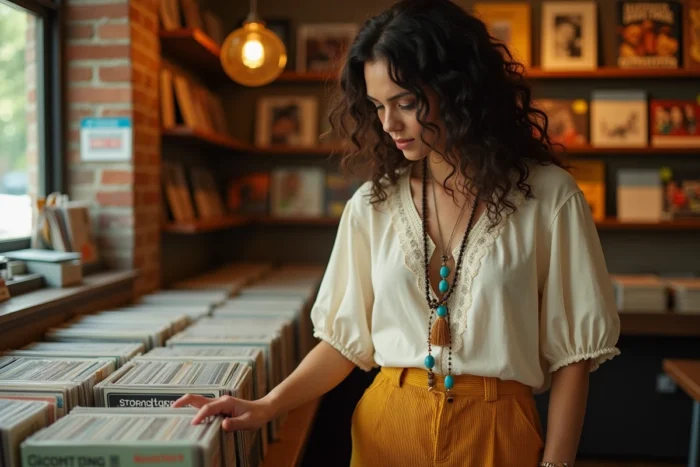
Flared pants and high-waisted jeans: choosing the right cut
Flared pants are the signature piece of the seventies look, but they are also the one that often misses the mark. The difference between a chic result and a costume relies on three specific parameters.
- The flare should start at the knee, not mid-thigh. A flare that starts too high widens the silhouette instead of elongating it.
- The high waist (positioned at the navel or slightly above) is non-negotiable. A mid-rise waist breaks the vintage proportion and creates a hybrid without a stylistic identity.
- The length should cover the heel of the shoe three-quarters of the way. A hem that is too short turns flared pants into just a contemporary flared pant.
In denim, we observe that rigid fabrics (like selvedge) produce a sharp and graphic flare, while stretch jeans provide a softer movement, closer to the bohemian style. The choice depends on the intended vibe.
Raw denim or washed denim
Raw denim anchors the look in an urban and sophisticated register. Paired with a lace blouse or a bow-tie shirt, it avoids a festival-like appearance. Washed denim, on the other hand, leans towards a more overt vintage spirit. It works better with suede boots and a fringed vest.
Long printed dress: selecting the right pattern to avoid a costume
The choice of pattern alone determines the credibility of the look. Small-scale floral prints (like liberty or paisley) are the most versatile. They can be worn in the city or on vacation without tipping into a folkloric register.
Psychedelic patterns (spirals, saturated geometric shapes) remain confined to event use. On a long dress worn daily, they overwhelm the eye and complicate accessorizing.
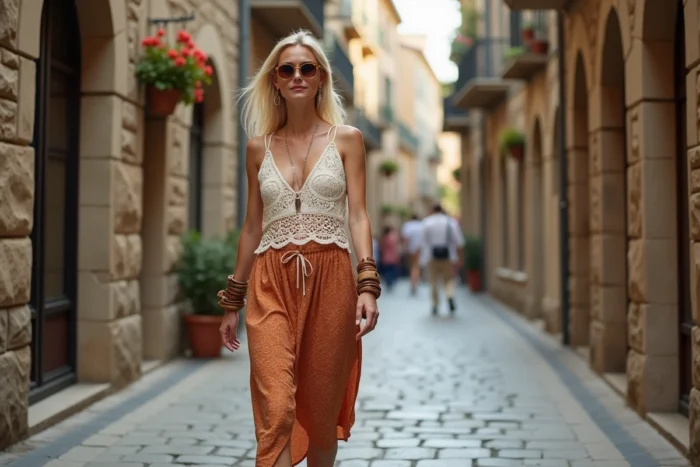
The most reliable palette for a chic hippie style revolves around earthy tones: ochre, terracotta, sage green, chocolate brown. These shades recall the naturalistic aesthetic of the movement without the chromatic overload that dates a garment. Off-white or ecru also work well as main pieces, especially in embroidered dresses or pagoda-sleeve blouses.
Embroidery and lace: balancing ornamentation
One embellished piece per outfit is sufficient. Wearing a brocade dress, a fringed bag, and stacked ethnic jewelry simultaneously creates an accumulation that dilutes the chic effect. The principle of a single focal point remains the safest rule to modernize the seventies wardrobe.
Boots and hippie fashion accessories: the finishes that change the vibe
Shoes direct the look more than any other piece. For a chic hippie style, three options stand out clearly.
- Block-heeled suede boots (moderate height) are the most coherent choice. They elongate the leg under flared pants and visually anchor the look in the 70s.
- Strappy sandals in natural leather are suitable for summer outfits, provided they remain flat or have a wedge heel. Too thick soles (like exaggerated platforms) veer towards disco, a different vibe.
- Round-toed ankle boots in aged leather offer an autumnal alternative. Worn under a long dress, they create an interesting texture contrast.
On the accessory side, a wide-brimmed felt or straw hat is enough to establish the bohemian spirit. Round glasses with thin frames remain an effective classic. For jewelry, favor handcrafted pieces in oxidized metal or raw stones rather than shiny costume jewelry that modernizes the look too much.
Soft leather bags (crossbody, bucket bag) complete the silhouette without overwhelming it. A model in vegetable-tanned leather, which patinas over time, perfectly aligns with the philosophy of a sustainable and timeless wardrobe.
The chic hippie style is not just about stacking vintage pieces. It’s a work of materials, proportions, and restraint. A wardrobe built around three or four well-chosen pieces (a flawless high-waisted jean, a quality long viscose dress, suede boots, a handcrafted accessory) covers most situations without ever falling into caricature.