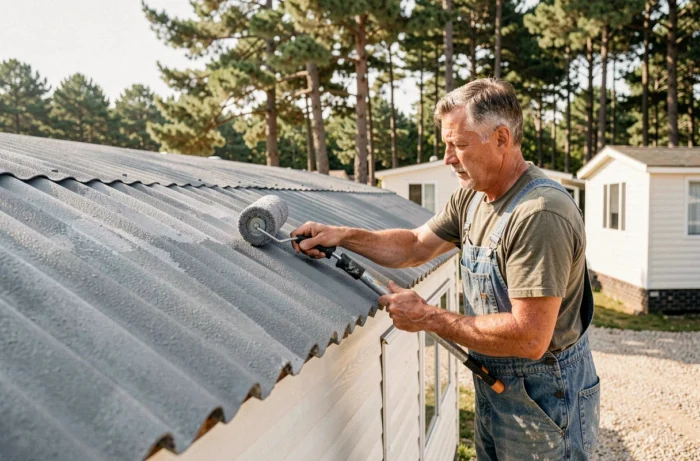
The roof of a mobile home ages under a thermal regime that few traditional buildings experience: direct solar exposure without ventilation under the slope, high temperature fluctuations between summer and winter, and water stagnation on low slopes. Choosing a paint to renovate this surface is not just about selecting a color. The substrate itself poses a problem because it often combines several materials over a few square meters, with assembly joints that degrade well before the panels do.
Mobile home roofing materials: why compatibility is more important than brand
A mobile home roof is not a homogeneous surface. Depending on the model and year of manufacture, you may find fiberglass-reinforced polyester, lacquered aluminum, galvanized steel, sometimes PVC, or sandwich panels with an insulating core. These materials coexist on the same roof, connected by profiles and joint sealants.
What distinguishes a successful project from an early failure is the ability of the paint system to adhere to each of these substrates simultaneously. A paint formulated for galvanized steel may not adhere well to polyester. A flexible sealing resin will be perfect on the joints but may risk peeling off aluminum without the appropriate primer.
Before even comparing products, you need to identify each material present on your roof. A simple test involves rubbing a small corner with a mild solvent: polyester remains inert, PVC softens slightly, and aluminum shows a metallic shine beneath the oxidation layer. This step conditions everything else in the project, including the choice of the bonding primer.
By selecting the right roofing paint for mobile homes suited to your substrate, you avoid the classic trap of a universal product that only lasts a few months on a poorly identified material.
Aging joints and cracks: the invisible work before painting
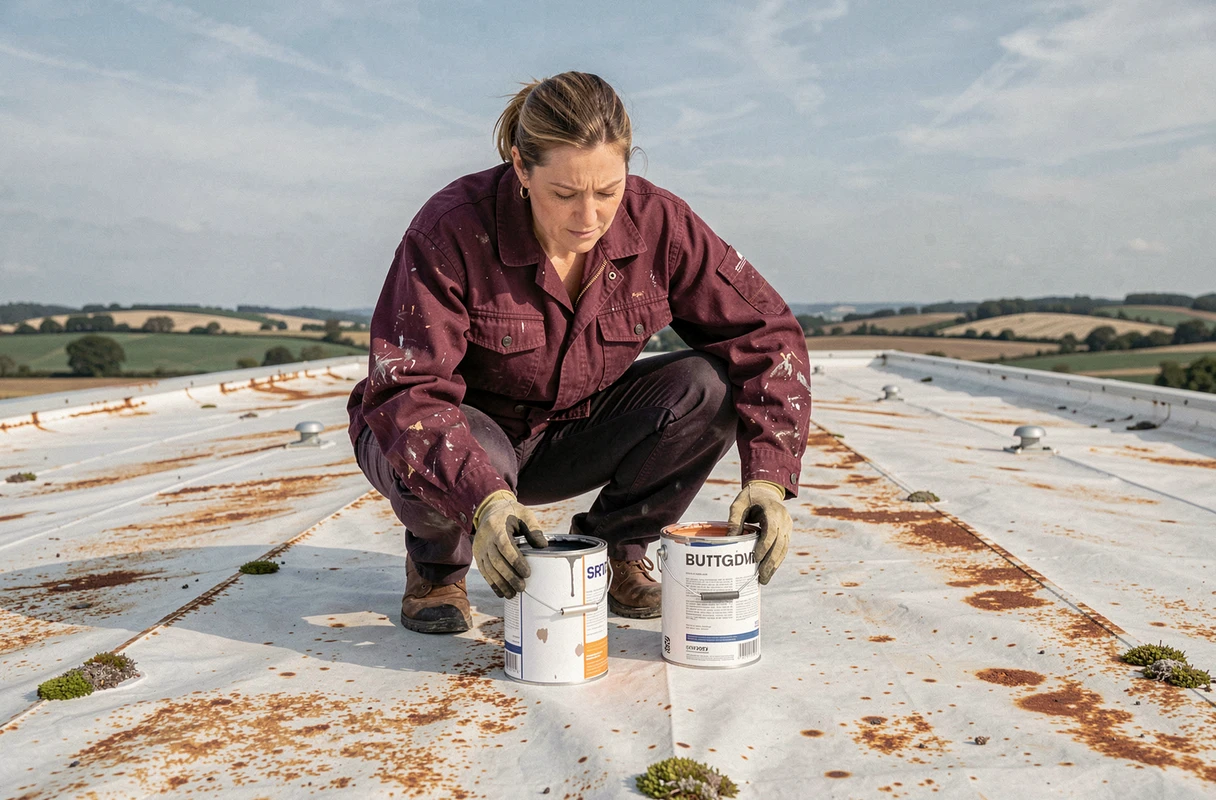
Painting a mobile home roof without treating the joints is like applying a coating to a cracked wall. The problem reappears in just a few seasons, sometimes in a few weeks under intense heat.
The original sealants, often made from polyurethane or silicone, lose their elasticity after several years of UV exposure. They shrink, crack, and create microscopic water pathways that are not always visible to the naked eye. The paint alone, even if waterproof, does not compensate for this structural failure.
Preparing the joints before any application
Preparation involves removing degraded sealants, cleaning the joint bottom, and reapplying a sealant compatible with the future paint. This is a lengthy step, visually ungratifying, but it determines the longevity of the result.
- Mechanically remove cracked or detached sealants without attacking the substrate with too aggressive a tool that could scratch the aluminum or polyester.
- Degrease the junction areas with an appropriate cleaner (no acetone-based products on PVC, which dissolves it).
- Apply a flexible sealant compatible with the chosen paint, respecting the complete drying time before painting over it.
- Check the rivets and fasteners: a rusty rivet creates an infiltration point that the paint does not seal.
Field reports vary on the durability of hybrid MS polymer sealants compared to traditional polyurethanes. The choice depends on the roofing material and the exposure of the mobile home.
Cool roof reflective paint on mobile homes: beyond aesthetics
The term “cool roof” refers to a family of reflective coatings designed to reduce solar absorption. On a mobile home, the interest goes beyond simply reducing indoor heat in summer. These products also limit the thermal expansion of roofing materials, which slows down the degradation of joints and reduces mechanical stress on fasteners.
A cool roof coating is not an ordinary white paint. Its formulation includes reflective mineral fillers and a resin capable of withstanding UV rays without yellowing or cracking. The UV resistance of the binder is as important as the reflective power of the pigments.
What the cool roof does not solve
This type of paint does not replace interior thermal insulation or prior waterproofing treatment. On a roof that is already cracked or has failing joints, applying a cool roof creates an illusion of protection. Indoor heat decreases, but water continues to infiltrate.
The question of layer thickness also deserves attention. The market is shifting towards multi-layer systems (preparation, primer, then two finishing coats) rather than a single product applied in one pass. A multi-layer system tolerates substrate movements better and offers improved long-term waterproofing.
Concrete criteria for choosing mobile home roofing paint
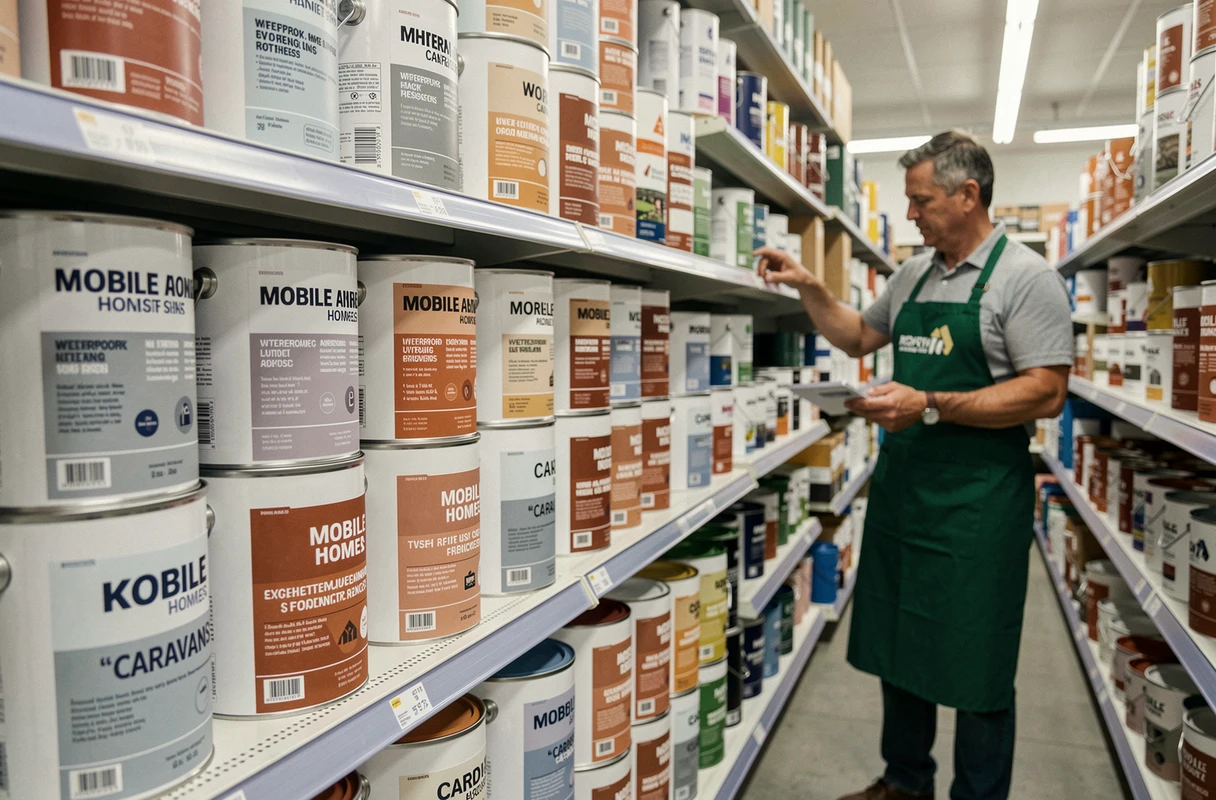
Rather than a list of brands, here are the technical parameters that allow for an objective comparison of available products.
- Elasticity of the dry film: on a mobile home, the roof expands and contracts with temperature variations. A rigid paint cracks, while a flexible paint follows the movements of the substrate.
- Multi-substrate adhesion: the product must adhere to at least two of the materials present on your roof (aluminum, polyester, galvanized). Check the manufacturer’s technical data sheet, not just the commercial description.
- Resistance to water stagnation: mobile home roofs have low slopes. The paint must withstand temporary puddles without degrading or blistering.
- Compatibility with a primer: a bonding primer suitable for the substrate significantly improves the lifespan of the system compared to the choice of the finishing coat itself.
Color comes last in the decision-making process. A light shade reduces absorbed heat, but a quality reflective coating in a medium shade can outperform a standard white paint whose formulation is not designed for solar reflection.
The true differentiating factor remains the preparation of the substrate. A well-prepared roof with an average product lasts longer than a poorly prepared roof with a high-end product. This is a recurring observation in discussions among mobile home owners, and renovation professionals confirm it.