
The associative support for people without residence permits is not limited to directing them to a service desk. The added value of a specialized structure lies in its ability to coordinate legal assistance, access to social rights, and administrative follow-up over time, taking into account the specific profile of each individual.
Proximity legal support: the lever that generalist services do not cover
Most articles on the subject list associations without distinguishing the level of legal expertise offered. We observe that the difference between an information desk and a structured legal support radically changes the outcome of a regularization case or an appeal.
Several associations, including Cimade and France terre d’asile, have trained volunteers in immigration law who do not just provide information. They review documents, identify procedural flaws, prepare appeals to the administrative court, and refer to specialized lawyers when the case requires it.
This local network has become professionalized. The desks no longer operate solely from a national headquarters: they are deployed in regions, sometimes without appointments, with dedicated phone slots. Cimade, for example, maintains active regional branches in most French metropolitan areas.
To structure a process of support for undocumented migrants with an association, it is essential first to identify the type of service desk suited to the profile of the person being assisted, which requires knowledge of the legal distinctions between situations.
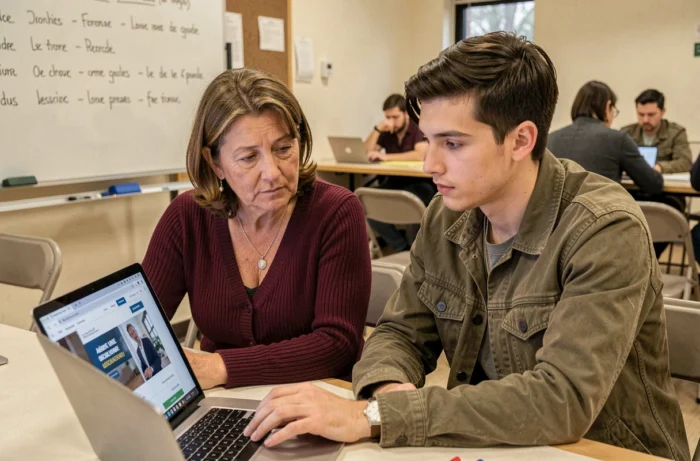
Profile of the person being assisted: undocumented, asylum seeker, or refugee, the procedures differ
An undocumented person in the strict sense (a foreign national present in the territory without a valid residence permit) does not have the same contacts as an asylum seeker in the process or an unaccompanied minor. Confusing these statuses leads to inappropriate referrals and critical time losses.
Undocumented persons in an irregular situation
Regularization through employment remains the most documented pathway. It requires compiling a file at the prefecture with proof of presence in the territory, pay slips or job offers, and sufficient seniority. Associations like Secours Catholique or the Romeurope network assist with this type of case.
Asylum seekers and refugees
Asylum seekers follow a distinct circuit that begins with registration at the prefecture’s single desk and then with OFPRA. France terre d’asile manages reception centers (CADA) and provides initial support with information about rights. Statutory refugees, on the other hand, have access to integration programs that organizations like Réfugiés Bienvenue facilitate, particularly for housing.
Unaccompanied foreign minors
Their care falls under child protection, but associations play a role in monitoring and directing them to departmental councils. France terre d’asile has dedicated programs for this audience.
Material assistance and access to social rights: what is at stake before regularization
Waiting for regularization to access housing or healthcare is not realistic. Immediate material assistance conditions the ability to carry out administrative procedures. A person on the street, without access to a mailbox or a phone, cannot follow a case at the prefecture.
- Emergency housing via 115 or the Paris social emergency service often constitutes the first link. Associations direct individuals to these public services and complement them with day shelters (such as Halte humanitaire in Paris or Austerlitz reception).
- Access to healthcare goes through health access desks (PASS) in public hospitals and state medical assistance (AME). Médecins du Monde intervenes for individuals in irregular situations who cannot assert this right.
- Administrative domiciliation, essential for receiving official mail, is provided by certain accredited associations and CCAS. Without domiciliation, no procedure at the prefecture will succeed.
We recommend addressing these three aspects in parallel from the first contact with the person being assisted. The classic mistake is to focus on the legal file while neglecting the material conditions that allow it to be maintained over time.
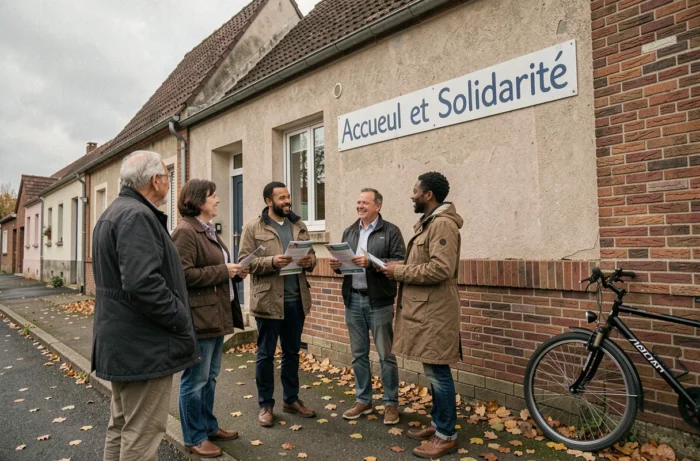
Training and literacy: underutilized levers by volunteers
Several associations have developed programs that go beyond the strict framework of the right to stay. Literacy and French as a foreign language (FLE) courses are not only for future integration: they enhance the individual’s autonomy in their own procedures.
A sufficient level of French reduces dependence on interpretation during appointments at the prefecture or before the courts. Organizations like JRS France or local associations offer sociolinguistic workshops open to individuals without residence permits.
Referring individuals to vocational training, when the legal framework allows, constitutes an additional argument in a regularization case through employment. Some sectors in tension accept job offers that facilitate the processing of the case at the prefecture.
Coordinating volunteer action: mistakes to avoid
Volunteering with undocumented persons requires a rigor that goodwill alone does not guarantee. Here are the most common pitfalls we observe in the field:
- Giving legal advice without training: incorrect information about an appeal deadline or required documents can permanently jeopardize a case. The volunteer must know the limits of their role and refer to a trained legal professional.
- Neglecting confidentiality: information about the administrative situation of an undocumented person is sensitive. Its dissemination, even unintentionally, can have serious consequences.
- Underestimating the psychological dimension: the fear of deportation, isolation, and precariousness generate distress that administrative support alone cannot address. Referrals to psychological support services are part of the overall assistance.
The effectiveness of an association relies on the complementarity between trained volunteers, specialized lawyers, and social workers. Each link has a defined scope. When this distribution is respected, the rate of successfully completed cases increases significantly, and the person being assisted retains their ability to act in a process that remains, by nature, long and uncertain.