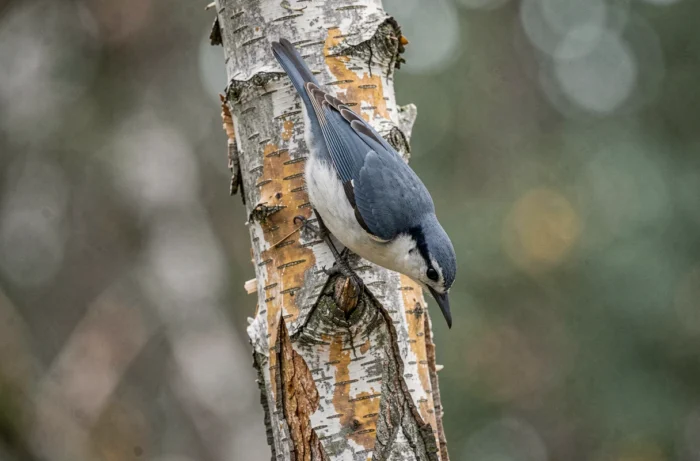
A small bird lands on the balcony railing. Gray plumage on top, white belly. By the time I look it up in a guide, it has disappeared. This situation is familiar to all beginners in ornithology. Identifying a gray and white bird requires a simple method: observe a few specific details before even searching for a name.
Size and silhouette: the first sorting before plumage color
The natural reflex when faced with a gray and white bird is to focus on the colors. This is a common mistake. Many species share this duo of shades, and color alone is almost never sufficient.
Start by estimating the size. Mentally compare the bird to three familiar references: a sparrow (small, stocky), a blackbird (medium size, elongated), a pigeon (large, round silhouette). This rough classification already eliminates the majority of possible species.
Next, look at the general shape. Is the tail long and thin, like that of a gray wagtail? Is the beak short and thick, suited for seeds? Thin and pointed, designed for insects? The silhouette provides more information than color when you’re just starting out.
To remember the name of a gray and white bird observed in the garden, note these three elements in order: approximate size, beak shape, tail length. This trio constitutes your basic identity card.
Distribution of gray and white: where to look for plumage clues
Once the silhouette is identified, colors become useful, but not in just any way. The question to ask is not “is it gray and white?”, but rather: where exactly are the gray and white located?
Crown, chest, belly: three areas to scan
In the coal tit, the crown (the top of the head) is black, the back is gray-brown, and the belly is whitish. In the gray flycatcher, the top is uniformly gray and the chest shows fine streaks. Two “gray and white” birds, two very different distributions.
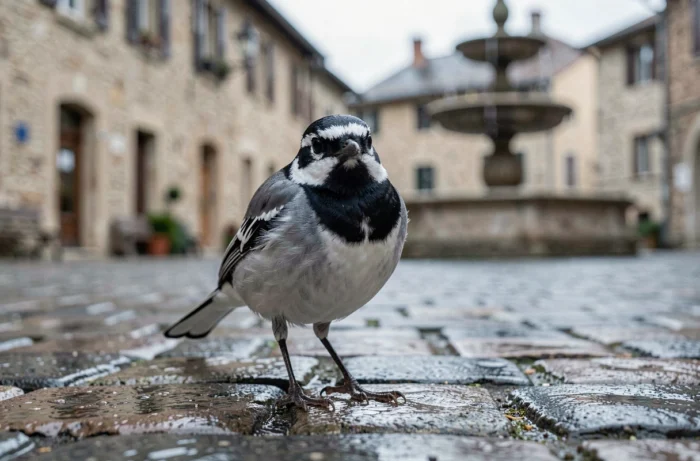
Identify the boundary between gray and white on the body. This boundary varies from species to species. In the gray wagtail, the contrast is clear: gray back, pure white belly, well-defined black throat. In the dunnock, gray blends with brown in a diffuse manner, without a clear demarcation.
Wing bars and distinctive markings
Some species have markings that clarify the debate. Wing bars (light or dark bands visible on the folded wing) are a reliable criterion. The tree sparrow, although more colorful, illustrates this principle well: its two white bars on the wing distinguish it immediately.
Did you notice a white spot on the sides of the tail when the bird took off? That’s a valuable clue. Several species display it, but combined with size and behavior, it often helps to make a decision.
Behavior and habitat: clues that plumage does not provide
A gray and white bird bobbing its tail while walking on the ground is very likely a wagtail. Another, of similar size, hanging upside down on a trunk, resembles a nuthatch. Behavior identifies as surely as plumage.
Here are the behaviors to note as a priority:
- Ground movement mode: walking, hopping, or perching. The gray wagtail walks while bobbing its tail, the black redstart hops on rooftops.
- Position in vegetation: on the ground, in low bushes, in the canopy. The dunnock often stays hidden close to the ground, while the gray flycatcher hunts from an exposed perch.
- Type of flight: undulating (like woodpeckers), direct and fast (like starlings), or fluttering with brief back-and-forth movements (flycatcher).
A gray and white bird on the ground that bobs its tail is almost always a wagtail. This type of behavioral shortcut works better than comparing shades of gray in a photo.
Photo and song identification apps: an effective shortcut for beginners
In recent years, AI identification apps have changed the game for novices. Tools like Merlin Bird ID or Lens App allow you to photograph a bird or record its song, then offer identification in a few seconds.
These apps work even with imperfect shots. A blurry bird on a branch, taken against the light with a phone: the app cross-references the shape, estimated size, geographic region, and season to refine its suggestion. For a beginner facing yet another gray and white passerine, this is often the quickest way to progress.
Song identification is particularly useful for discreet species. The dunnock, easily confused visually with a female sparrow, has a melodious and rapid song that immediately gives it away.
Be careful, these tools do not replace direct observation. They confirm or guide, but learning comes from the habit of noting the silhouette, behavior, and color distribution. The app validates what the eye has started to detect.
The three most common gray and white species in the garden
Rather than an exhaustive catalog, focus on three birds you will regularly encounter in France:
- The gray wagtail: gray back, white belly, long tail that it constantly shakes. Frequenting parking lots, flat roofs, riverbanks. Easy to recognize thanks to its behavior.
- The gray flycatcher: small passerine with gray-brown plumage on top, whitish streaked underneath. Stands upright on an exposed perch and makes short flights to catch insects before returning to the same spot.
- The dunnock: often confused with the sparrow, it is distinguished by its fine beak and habit of sneaking along the ground in hedges. Brown streaked back, slate gray head and chest, lighter belly.
Learning to recognize these three species provides a solid foundation. From there, each new gray and white bird observed can be compared to these known references, and the differences become apparent more quickly than one might think.