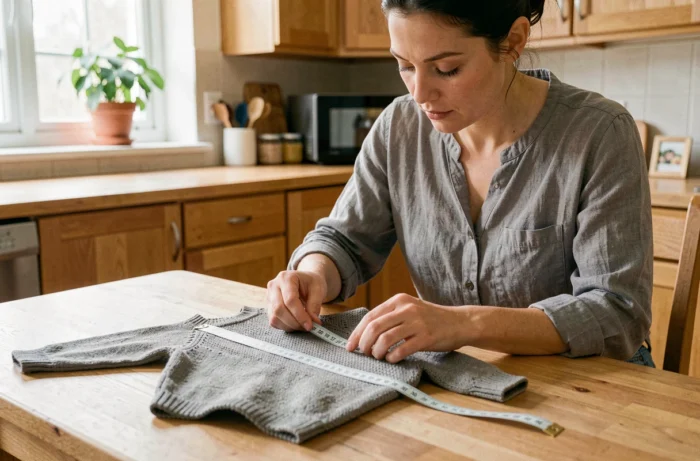
An item of children’s clothing found at a garage sale, a bag of clothes passed down by a cousin, a pair of pants with the tag cut off because it was itchy: we all end up with pieces that are impossible to locate on a standard size guide. The usual reflex, comparing with the age indicated on an online chart, simply doesn’t work without a brand reference. Here are concrete methods to determine the size of a child’s garment when the label has disappeared.
Flat comparison with a reference garment
The most reliable technique when you have neither a label nor an identifiable brand is direct comparison. Take a garment that fits the child well at the moment, lay it flat on a hard surface, and place the unknown piece on top.
Three areas are sufficient to decide: shoulder width, total length, and chest width. If the two pieces overlap within one or two centimeters on these three points, the size is suitable. For pants, compare the inseam length and waist measurement, waistband against waistband.
This method bypasses the central issue of second-hand children’s clothing: there is no universal size standard among brands. A “6 years” at one store may correspond to an “8 years” at another. Without a label, you don’t even know which reference you are dealing with.
The reference piece does not lie, as we have seen the child wear it. To determine the size of a child’s garment under these conditions, this is the most reliable starting point.

Measurements with a tape measure: the important reference points
When you don’t have a reference garment on hand, you move on to measuring the child. There’s no need to take ten measurements as you would for a sewing pattern. For ready-to-wear, three or four are sufficient.
Useful measurements for a top
- Chest circumference: tape measure passed under the armpits, at the widest part of the torso, without tightening. Then compare with the width of the garment laid flat, multiplied by two.
- Shoulder-hem length: from the top of the shoulder to the bottom of the garment. Measure the child from shoulder to hip for a t-shirt, from shoulder to knee for a dress.
- Shoulder width: measure the child from one shoulder tip to the other, then compare with the garment laid flat. If the garment is narrower by more than two centimeters, it will be too tight.
Useful measurements for pants
- Inseam length: from the inside of the thigh (at the highest point) to the ankle. This measurement determines whether the pants will drag on the ground or stop at the calf.
- Waist circumference: tape measure at the level of the navel, without compressing. A child’s pants with an elastic waistband can tolerate a few centimeters of difference, but beyond four centimeters, comfort is compromised.
Tip for children who can’t stay still: measure while they watch a screen, or use a string that you then transfer to the tape measure. The string gives a less precise result, but is generally sufficient for ready-to-wear.
Children’s sizes and correspondences: why generic charts can be misleading
On most websites, you will find age-size-weight correspondence charts. They are useful when you know the brand. Without a label, these charts become misleading because you don’t know which reference the manufacturer used.
The European standard EN 13402 recommends designating clothing sizes by body measurements (chest circumference, waist circumference, height in centimeters) rather than arbitrary sizes. In practice, this standard is not mandatory, and most children’s brands continue to indicate an age or a proprietary size.
Concrete result: two seemingly identical t-shirts, both intended for a six-year-old, can have several centimeters of difference in width and length. Some brands consistently size large, while others fit snugly. You can’t guess this trend without knowing the brand.
The only reliable data remains the physical measurement of the garment, related to the child’s measurements. A correspondence chart serves only as a secondary safety net, never as a primary criterion when the label is missing.

Second-hand children’s clothing: visual cues and quick sorting tips
At a flea market or thrift store, you don’t always have a tape measure in your pocket. A few visual cues allow for an initial sorting without tools.
For tops, fold the garment in half lengthwise and hold it against the child’s torso, from the neck down. If the bottom of the garment extends well beyond the waistband, it will be too large. If it stops above the navel, it will be too small.
For pants, use the method of wrapping the waistband around the child’s neck. Wrap the waistband of the pants (closed) around the child’s neck. If the two ends meet without forcing, the waist of the pants generally corresponds to the child’s waist. Returns vary on this point depending on the cut of the pants, but it works well on models with elastic waistbands, which represent the majority of children’s pants.
For sleeves, measure from the child’s wrist to the middle of their neck, arm extended horizontally. Then compare with the sleeve of the garment, measured from the wrist to the middle of the collar. If the two lengths are close, the sleeve will fit.
Last often overlooked point: check the ease around the hips and thighs, not just the waist and length. A pair of pants may seem correct in waist size but be restrictive around the thighs, especially for sporty children.
A child’s garment without a label is not a mystery to solve with charts, but a physical object to measure. Tape measure, reference piece, or neck method for quick sorting: these three approaches cover almost all situations, whether in a thrift store, in a bag of donated clothes, or facing a pile of laundry whose labels have long been torn off.