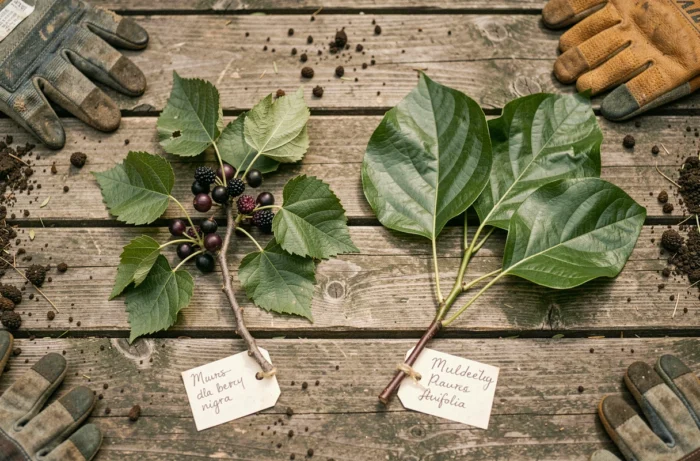
You observe a tree with broad and dense foliage in your garden, and dark fruits fall on the terrace in summer. Mulberry tree or plane tree mulberry? The confusion is common, as both trees belong to the same botanical genus, Morus, and share a misleading family resemblance. However, distinguishing them makes all the difference: one is cultivated for its mulberries, the other for its shade.
Botanical name of the mulberry: the trap of garden center labels
Before looking at the leaves or fruits, the first reliable reflex is to check the Latin name on the tree’s label. The term “plane tree mulberry” does not always identify a specific botanical species. In garden centers, it can refer to Morus kagayamae (also sold under the names Morus bombycis or Morus platanifolia), but also to a Morus alba trained in a parasol shape.
The fruiting mulberry, on the other hand, most often corresponds to Morus nigra (black mulberry) or certain cultivars of Morus alba (white mulberry) selected for the quality of their fruits. Only the botanical name and the cultivar allow for a reliable identification. If you have lost the label, other visual criteria take over.
To better understand the differences between fruiting mulberry and plane tree mulberry, cross-referencing several clues remains the most reliable method.
Leaves of the fruiting mulberry and the plane tree mulberry: what the shape reveals (and what it hides)
Have you noticed that the leaves of your mulberry change shape depending on the branches? This is normal, and it is precisely what complicates identification.
Lobed leaves or entire leaves
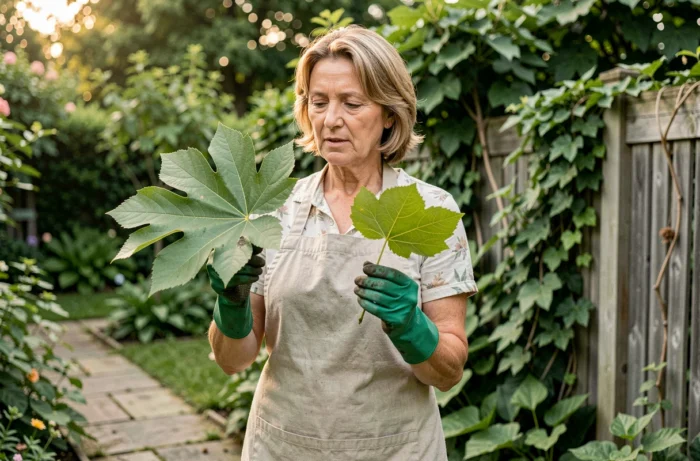
The plane tree mulberry usually has broad leaves, divided into three pronounced lobes, reminiscent of those of the plane tree. This is indeed the origin of its common name. The fruiting mulberry (Morus nigra) produces rather heart-shaped leaves, thick, rough to the touch, and rarely lobed.
With Morus alba, the situation becomes more complicated. A single tree can bear both entire leaves and deeply lobed leaves, depending on the age of the branch and the vigor of the growth. A lobed leaf “like a plane tree” does not therefore prove that you are facing an ornamental plane tree mulberry.
Texture and thickness: an underestimated clue
Touch the leaf. On the fruiting black mulberry, the underside is often downy, almost velvety. The leaf is thick, a bit rough. The ornamental plane tree mulberry has thinner, smoother leaves, with a glossy appearance on top.
Cross-referencing the shape, texture, and size of the leaf provides a much more reliable set of clues than a single criterion taken in isolation.
Fruits of the mulberry: color, size, and absence
One might think that the color of the fruit settles the debate. In reality, the color of the mulberry is not enough to identify the type of mulberry. A white mulberry (Morus alba) can produce white, pink, red, or almost black fruits depending on the chosen cultivar.
Here are the most discriminating criteria regarding the fruits:
- The black fruiting mulberry (Morus nigra) produces fleshy, juicy mulberries that are dark in color when ripe, with a pronounced tangy taste. They stain fingers and the ground significantly.
- The ornamental plane tree mulberry, in its sterile version (cultivar Fruitless or Morus kagayamae ‘Fruitless’), produces no fruit at all. This is indeed its purpose: to prevent stains on terraces and walkways.
- Some non-sterile plane tree mulberries bear small fruits, often less tasty and less abundant than those of the black mulberry. Their culinary interest remains limited.
If your tree produces abundant, juicy, and highly staining fruits every summer, it is very likely a fruiting mulberry. If no fruit falls, you probably have a sterile cultivar selected for shade.
Tree shape and use in the garden: parasol or orchard
Beyond the leaves and fruits, the overall silhouette of the tree provides a quick clue.
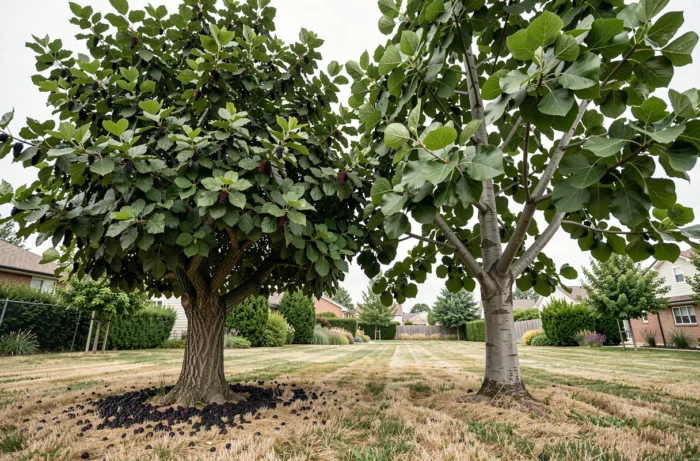
The plane tree mulberry is often trained in a parasol shape, with a short trunk and a wide, flattened crown. This directed pruning aims to increase the surface area of shade above a terrace or garden lounge. Its dense and deciduous foliage creates a true green roof in summer.
The fruiting mulberry adopts a more natural shape, often sprawling, sometimes irregular. Less pruned, it develops twisted branches with age. Its bark, on mature specimens, is more cracked and darker than that of the plane tree mulberry.
A mulberry pruned into a parasol shape near a terrace is almost always an ornamental plane tree mulberry. A tree with a free shape, planted away, with fruits that attract birds, points towards a fruiting mulberry.
Identification method using four crossed criteria
No single criterion guarantees reliable identification. Here is the practical grid to use:
- Botanical name on the label: Morus nigra (fruiting), Morus kagayamae ‘Fruitless’ or Morus alba ‘Kagayamae’ (sterile ornamental plane tree), Morus alba with fruiting cultivar (fruiting).
- Thick, rough, heart-shaped leaf: black fruiting mulberry. Thin, smooth, trilobed leaf: plane tree mulberry.
- Abundant, juicy, and staining fruits: fruiting. No fruit: ornamental sterile cultivar.
- Parasol shape, short trunk, directed pruning: plane tree mulberry. Free shape, twisted branches: fruiting mulberry.
By cross-referencing these four criteria, you can identify your tree with good reliability, even without the original label.
The fruiting mulberry and the plane tree mulberry sometimes coexist in the same garden without their owner knowing how to distinguish them. The texture of the leaves, the presence or absence of fruits, and the shape given to the tree remain the most accessible markers. If doubt persists, a photo of the foliage submitted to a local nursery will provide a definitive answer.